
When you’re busy, it’s difficult to get off the treadmill. You keep serving clients, answering questions, putting out small fires and telling yourself you’ll ‘take a proper look’ when things calm down. But they rarely calm down on their own.
This is why stepping back matters. Not for a weekend retreat or a grand reinvention, but for a simple, honest snapshot of where things are right now.
One of the quickest ways to do that is the wheel of life. It’s a straightforward tool that helps you assess eight areas of your life, spot what’s working, notice what’s drifting and turn the picture into a plan.
What is the wheel of life?
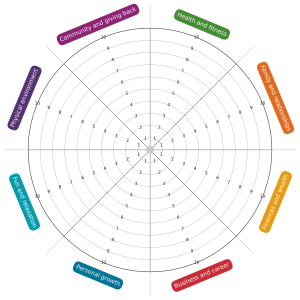
The wheel of life is a quick self-audit across eight areas. You score yourself out of 10 for each one, based on how satisfied you feel with that area today. That’s it. It’s simple on purpose.
The value isn’t in perfect scoring or deep analysis. The value is in creating a clear picture you can act on, instead of carrying everything as a vague sense of ‘I should probably sort that part of my life out.’ The eight areas aren’t fixed. They can be tweaked to suit you, your stage of life and what matters most right now.
For business owners, the wheel works because it shows the whole system, not just the business.
And whether you like it or not, the business is part of the whole system. It performs better when the rest of your life is steady. It suffers when the rest of your life is strained.
The eight wheel of life areas we use with business owners
There are different versions of the wheel of life. The one we use at Bill Squires Business Coaching is designed specifically for business owners. It reflects the reality of running a business and carrying responsibility.
The eight areas are:
Health and fitness
Health and fitness sits at the top for a reason. If you’re not healthy, you can’t perform. You can’t lead. You can’t think clearly. You can’t keep making good decisions day after day.
This isn’t about becoming an athlete. It’s about having enough energy, resilience and stamina to run your week without running yourself into the ground.
Family and relationships
This includes your partner, children, family and friends. The quality of your relationships affects everything. When things are strained at home, you feel it at work. When work spills into every evening, relationships pay the price.
Business owners often say they’re ‘doing it all for the family’, but the business can quietly take them away from the very people they’re trying to provide for.
Finances and wealth
This isn’t just ‘money.’ It’s the bigger picture.
How secure do you feel? How confident are you about the future? Are you building wealth, or just paying bills? Do you feel in control, or constantly behind?
For business owners, this also includes how the business supports your personal financial goals, not just whether it covers payroll.
Business and career
This is the obvious one, and it matters. How are you performing? How does the business feel to run right now? Are you doing the work you enjoy, or stuck in work you tolerate?
For some owners, this area is high because the business is thriving. For others, the numbers might be fine, but the stress is relentless.
Personal growth
This is about learning, development and progress.
Are you still growing, or are you just coping?
When you stop learning, your world shrinks. When you keep developing, you make better decisions and you open up new options, both personally and professionally.
Fun and relaxation
Many owners score this one low and then laugh. But fun and relaxation shouldn’t be optional or a ‘nice to have.’
Rest, downtime and enjoyment aren’t rewards you earn after you’ve ‘finished.’ They’re part of staying effective. They help you think, reset and come back with better judgement.
Physical environment
This relates to both your working environment and home environment. Is your space helping you, or draining you? Is it calm and organised, or chaotic and cluttered? Does it support the way you want to live and work? Your environment affects your focus and mood more than most people realise.
Community and giving back
Some versions of the wheel use spirituality. We often use community and giving back. This is about connection beyond your immediate circle.
It might be involvement in your community, supporting a cause, mentoring, volunteering, helping others, or simply feeling that you contribute to something bigger than your own goals. For many people, this becomes more important as they get more established.
Talk through your wheel of life
How to score the wheel of life (and why you can’t pick seven!)
To give yourself an accurate picture, firstly, be totally honest with yourself. Then use the wheel of life and give each area a score out of 10.
A score of 10 doesn’t mean ‘perfect.’ It means you’re genuinely happy with it right now. A score of one doesn’t mean ‘failing.’ It means it’s a problem area that needs attention.
One simple rule makes the exercise more useful. No sevens.
Seven is sitting on the fence. It’s the ‘comfortable’ score. It’s the one people choose when they don’t want to admit it’s not great, but they also don’t want to say it’s bad. If you’re tempted to pick seven, decide which side of the fence you’re on.
Is it really a six, meaning it needs work? Or is it an eight, meaning you’re happy with it and it’s not urgent? The small push forces honesty. And honesty is what turns the wheel from a nice idea into something that changes how you act.
What your wheel of life scores are telling you
Once you’ve scored all eight areas, the wheel gives you two things straight away.
First, it shows you what’s going well. Your high scores matter. They show you what you’re doing right and what to protect. They often reveal the habits or routines that are supporting you, even if you’ve taken them for granted.
Second, it shows you what isn’t going well. This is the bit most people want to skip, but the lower scores are where your best potential is usually hiding. When one area is weak, it often drags the others down with it.
For example:
- If health is a four, you’ll feel it in patience, decision making and energy
- If relationships are strained, you’ll carry that stress into the business
- If finances feel tight, it’s hard to think long term or make calm choices
The wheel of life makes this visible, replacing a general sense of pressure with a clear set of signals. Once you can see the signals, you can decide what to do.
Why the wheel of life matters to business
 Some owners look at the wheel and think it feels quite personal. And yes, it is. But it’s also practical, because the business doesn’t run on spreadsheets alone. It runs on you. Your energy, focus and judgement shape everything.
These elements shape how you lead your team, how you handle clients, how you respond to problems and how you make decisions under pressure. If your wheel is lopsided, the business becomes harder to run. You become more reactive. You tolerate more. You stop making time to think.
That’s when performance drops, even if you’re still working hard. The wheel of life helps you step back early, before it becomes a crisis and gives you a way to correct course while you still have options.
Turning the scores into a simple plan
The wheel isn’t the plan. It’s the starting point. The real value comes when you turn the results on the wheel into a few practical actions.
Here’s a simple way to do that:
1) Choose one or two areas to lift first
Don’t try to fix everything at once. Pick one or two areas where a small improvement would make the biggest difference. That’s often the lowest score, but not always. Sometimes you pick the area that’s causing the most knock-on impact.
- If health is low, start there
- If finances are creating constant stress, start there
- If business and career is high but relationships are low, be honest about the trade-off you’re making and decide what you want to change
2) Define what ‘one point better’ looks like
Don’t aim for a 10. Aim for one point better. If health is a four, what would a five look like in real terms?
- More sleep?
- A couple of walks a week?
- Fewer takeaway meals?
- A regular gym slot?
- A consistent bedtime?
If fun and relaxation is a three, what would a four look like?
- Date night with your partner?
- A hobby you restart?
- A weekend day with no work?
- A holiday booked, not just talked about?
One point better keeps it realistic and achievable.
3) Pick one action per area
Choose one simple action for each of the areas you’re improving. Keep it specific. ‘Eat better’ isn’t an action. ‘Take lunch away from my desk three days a week’ is.
‘Be more present’ isn’t an action. ‘Phone my mum every Sunday’ is.
The action should be small enough that you’ll actually do it, but meaningful enough that it will shift the score.
4) Put it in the diary
If it matters, it goes in the diary. Most people don’t fail because they lack motivation. They fail because they rely on willpower and memory.
Make it simple:
- Schedule the walk
- Block the evening
- Book the appointment
- Put the review date in your calendar
A plan only becomes real when time is allocated.
5) Review monthly or quarterly
The wheel of life works best when you revisit it – not obsessively, but regularly. A monthly check-in keeps you honest. A quarterly review helps you spot trends.
If you’re improving, you’ll see it. If you’re slipping, you’ll catch it earlier. And because the areas are connected, progress in one area often lifts others too.
A 10-minute exercise you can do today
If you want to try this now, here’s a simple process.
- Write down the eight areas:
- Health and fitness
- Family and relationships
- Finances and wealth
- Business and career
- Personal growth
- Fun and relaxation
- Physical environment
- Community and giving back
- Score each one out of 10.
- Go with your first instinct
- No sevens!
- Circle the one or two areas you want to lift first.
- For each, define what ‘one point better’ looks like.
- Choose one action per area and put it in the diary.
Where the circle of life and business coaching work together
Sometimes the wheel shows you something you already know but haven’t wanted to face. Other times it shows you a problem you can solve with a quick tweak.
For business owners, the scores that often feel hardest to shift are finances and wealth; business and career; and fun and relaxation.
Not because they’re impossible, but because they’re linked to deeper structural issues in the business.
Things like:
- The business depending too heavily on you
- A lack of clear priorities
- Weak systems and inconsistent delivery
- Pricing that doesn’t match the value you deliver
- A plan that exists in your head, not in the diary
That’s where coaching helps. Not by telling you what you ‘should’ do, but by helping you turn an honest snapshot into a practical plan, with clear actions and accountability.
Book a review of your wheel of life
If you’d like to go through the wheel of life and turn it into an actionable plan, please book a complimentary review using the link below.
It’s a simple starting point that often leads to better decisions, more balance and a business that supports the life you’re trying to build.