 In the Five Box Model, marketing and sales do the work of attracting and converting the right customers at the right price. Operations is where you deliver on those promises.
In the perfect version of the Five Box Model, you’ve already sold at 100% conversion and at your optimum price. The operations box then answers a simple question:
Are we delivering what we sold in the way the customer expects every single time?
To get close to that ideal, we need to understand two things:
- What great operations performance looks like
- What limits your ability to deliver it
What do ‘perfect’ operations look like
In our framework, there are three key measures for the operations box:
- In full
- On time
- In spec
You’ll sometimes hear this shortened to IFOTIS. But what does it mean in practice?
In full
You deliver everything the customer ordered. Not most of it. Not ‘we’ll send the rest when it comes in’. The full product or service is delivered as agreed.
For a service business, that might mean delivering every element of a package. For a manufacturer, it might mean the whole quantity shipped in one go.
On time
You deliver when the customer expected it.
That could be a specific date, a time window, or a service-level agreement. The detail varies by business, but the principle is the same. The client gets what they bought when they were expecting to receive it.
In spec
You deliver to the standard that was promised.
‘In spec’ means quality, scope and performance all match what was agreed at the point of sale. For example:
- The software does what you said it would do
- The manufactured item meets the drawing
- The report answers the brief
If you deliver in full, on time and in spec, you’ve laid the foundations for strong customer satisfaction. But the Five Box Model goes further and asks you to look inside your operation too.
Build IFOTIS into your business
Beware of the limiting constraint in your business
Even if every order looks the same to a customer, inside your business there’s nearly always one (or more) step that limits how much you can deliver.
This is the limiting constraint or the bottleneck. It’s the slowest step in the process. The place where work queues up. The part that sets the pace for everything else.
In most businesses, the limiting constraint tends to fall into one of four areas:
- People
- A piece of equipment
- Materials
- Cash
To move the operations box towards ‘perfect,’ you need to know which it is in your business and manage it carefully.
People as the limiting constraint
In many organisations, the limiting step is a group of people with a particular skill.
It might be a specialist engineer, a designer, a project manager or a small team that everything else depends on. If they’re overloaded or working inefficiently, everything slows down.
In this case, perfect operations would mean:
- Those people are working at 100% efficiency for the time you’re paying them
- Their work is well organised and prioritised
- They’re not constantly interrupted, pulled into non-essential tasks or waiting for information
If you find you can sell more but this group is constantly at capacity, that’s a sign you either need to improve efficiency or add more of that resource.
Equipment as the limiting constraint
In some manufacturing or production environments, a particular machine is the bottleneck.
If you can only process as much as that machine can handle, it becomes the heartbeat of your operation.
Perfect operations here means:
- Keeping that piece of equipment running at its optimum speed
- Minimising downtime, changeovers and breakdowns
- Planning work so it’s always fed with what it needs next
If demand grows and the machine is already running as efficiently as it can, you might need a faster model or a second one.
Materials as the limiting constraint
Sometimes, you can only produce as much as you can get hold of.
If key materials are scarce, subject to long lead times or unpredictable in quality, they become your limiting factor.
In this situation, perfection means:
- Securing enough of the right materials in advance
- Building strong relationships with suppliers
- Reducing waste so you use every bit effectively
If you’re confident you can sell more, you’ll be looking at diversifying suppliers or renegotiating terms so materials stop holding you back.
Cash as the limiting constraint
For some businesses, the issue isn’t people, equipment or materials. It’s money.
You know what you need. You may even know how to get it. But if you don’t have the cash to invest, everything slows down.
Here, perfect operations would mean:
- Using the cash you do have on the most effective items
- Prioritising investments that free up or generate more cash
- Aligning operational decisions with your broader financial plan
Once cash stops being the bottleneck and demand is strong, you can invest in more of the limiting resource, whether that’s people, equipment or stock.
Need help identifying your limiting constraint? Book an appointment to chat through you operations.
The five measures for operations
Putting this together, operational performance should be assessed with five measures:
- Do we deliver in full?
- Do we deliver on time?
- Do we deliver in spec?
- Is our limiting constraint running at 100% efficiency?
- Do our customers score us at 100% satisfaction?
You may not hit 100% on every measure, but these questions tell you where you are now and where you need to improve. Crucially, they also give you something you can track. These aren’t abstract ideas. They can be turned into key performance indicators and measured week by week.
What to do when you find your bottleneck
So, what happens once you know what your limiting constraint is?
You focus your effort there.
Because the bottleneck sets the pace for your whole operation, any improvement you make at that point has a disproportionate impact.
In practice, that means:
- Keep the bottleneck running
Make sure the limiting resource is always working on value-adding activity at its optimum speed. Avoid idle time. Avoid ‘busy work’ that doesn’t move orders forward. - Protect it from distractions
If your constraint is a specialist team, don’t constantly pull them into meetings or tasks that don’t require their expertise. If it’s a machine, plan maintenance and changeovers carefully. - Feed it properly
The bottleneck should never be waiting for information, materials or decisions. Organise the steps before it, so work arrives in the right order, in the right state and at the right time. - Invest where it matters
If you can sell more and you have the cash, the model is very simple. Increase the capacity of the bottleneck. That might be additional staff, extra training, upgraded equipment or more stock.
As you do this, keep one eye on demand and one eye on cash. There’s no point in adding capacity if you can’t sell it or afford it. This is where the finance and analysis box in the model will come in next.
Measuring operations as part of the Five Box Model
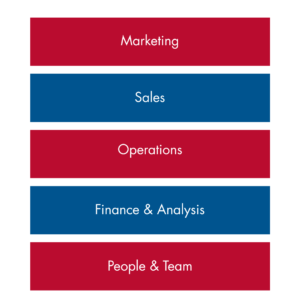 The operations box doesn’t stand on its own. It sits between sales and finance & analysis.
- Marketing and sales bring in work at the optimum price
- Operations delivers that work in full, on time, in spec, with efficient use of the limiting resource and high customer satisfaction
- Finance & analysis then take the data from operations and turn it into insight
To move towards the ‘perfect’ operations box, you don’t need to overhaul everything at once. Start by:
- Defining what ‘in full, on time, in spec’ means in your business
- Identifying your limiting constraint
- Measuring performance on the five key measures
- Taking focused action where it will have the biggest impact
Over time, this gives you an operation that feels smoother for your team and more reliable for your customers.
And when operations runs well, the whole Five Box Model becomes more powerful. Your marketing and sales effort isn’t wasted, your customers are happier and your financial performance is easier to understand and improve.
In the next blog, we’ll look at the finance & analysis box and how it ties all of these measures together.