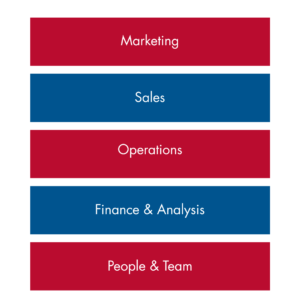
 The second box in the Five Box Model is Sales. If marketing brings in the leads, sales turns those leads into clients. The goal is simple and that’s to convert every appropriate lead into a successful client and, in doing so, build a full order book.
That word ‘appropriate’ matters. Not every lead is a good lead, and not every prospect should become a customer. The perfect business converts the right leads – at the right price – through a clear, consistent process.
Define what success looks like
 Start by asking one question: What’s our current conversion rate?
The goal, in theory, is 100%. Anyone can achieve a 100% conversion rate if they give everything away for free, but that’s not the aim. The aim is to reach the optimum conversion rate at the right price.
This is where sales and pricing meet. Many people price on cost plus margin or simply match the market. But effective selling is all about value.
Yes, you should understand your costs, and yes, you should know what the market can stand. But real pricing power comes from understanding the value you deliver.
Think about cars. There’s a market from Fiat to Ford to Audi to Rolls-Royce. Each one has a different value proposition. Where do you want to sit? What value do you offer that justifies your price? The stronger your value story, the stronger your price position. And the easier it is to close a deal.
Create a repeatable sales process
Most businesses don’t have a sales process. They have sales activity. A process is something you can follow, test and improve. It’s written down, it’s trained and it’s repeatable.
The process should take you from enquiry to order with a clear set of steps, supported by consistent communication.
People rarely buy after one conversation. The average prospect spends around seven hours across 11 touch points and four different media before deciding. That might be a mix of calls, meetings, emails, written content and videos. The sales process needs to support those multiple interactions, not rely on a single pitch or channel.
Help me build a repeatable sales process
Focus on the future, not the past
Most salespeople spend too much time talking about themselves – how long they’ve been in business, who they’ve worked for, how many awards they’ve won. That’s all about the past.
The prospect, however, is only interested in one thing. The future. Their future. The question every prospect is silently asking is, ‘Is this the right person to help me achieve the future I want?’
Your salesperson’s job is to uncover what that future looks like. They need to ask what the prospect is hoping to achieve and help them define it clearly. Many clients can’t articulate it until they’re guided through the conversation. Then, their desires and aspirations should be reflected back to them in the proposal. That’s how your salesperson shows they’ve listened and understood.
Build proposals around the client, not the company
When it comes to proposals, my golden rule is don’t just email them. A proposal is a conversation, not a document. Sending it by email invites a silent ‘no.’ It should be presented instead, preferably in person, so the offering can be explained, discussed and refined.
Too many proposals are ‘gobbledygook and price’ – just a list of technical details followed by a number.
Instead, describe what the client will gain. Don’t list the features – talk about the benefits and what your product or service will bring to them. Describe how their life or business will be better when they start to work with you. Show them what’s in it for them.
Your proposal should begin not with ‘About us’ but with ‘Our current understanding of you.’ Use the first couple of pages to summarise:
- What we understand about your goals
- What you want to achieve
- What success looks like for you
At the end of the presentation, the magic question should be asked. And that is ‘What have we missed?’
It’s open, humble and powerful. If the client replies, ‘Nothing… you’ve captured it perfectly,’ your salesperson is more than halfway to a sale. They’ve demonstrated understanding, expanded your prospect’s thinking and earned trust before even mentioning price.
If they do add something new, you’ll gain extra insight no one else will have and the proposal can be adjusted accordingly.
That’s what professional selling looks like.
Handle price with confidence
If price objections come up, don’t panic. Return to the agreed list of outcomes. If the price feels too high, the prospect can be asked which of the outcomes they’d like to be removed. It reframes the conversation around value. Your business won’t be discounting, but adjusting the scope to fit their budget. It’s calm, professional and effective.
Measure conversion where it matters
Finally, sales performance needs to be measured properly. Not just overall, but by source and by salesperson. A referral from an existing client will almost always convert better than a cold Google lead. Each source should be measured separately.
If you have a team, conversion rates will also vary by salesperson. That’s natural. Experienced team members will usually outperform new ones, But a consistent process and good training should narrow the gap over time.
Business owners shouldn’t rely on what salespeople say their conversion rate is. They’ll often over-estimate. This isn’t from malice, but from optimism. Measure it in your systems. Track it accurately.
This is where the next box, Finance and Analysis, comes in. Analysing those numbers across lead sources and salespeople gives you the insight to improve.
Bringing it together
Sales isn’t about slick talk or luck. It’s about structure, discipline and empathy. A business – and it’s salespeople – should know the value, follow the process, talk about the client’s future and measure what works.
If you get those right, you’ll fill the order book and build a business that wins the right clients at the right price, every time.